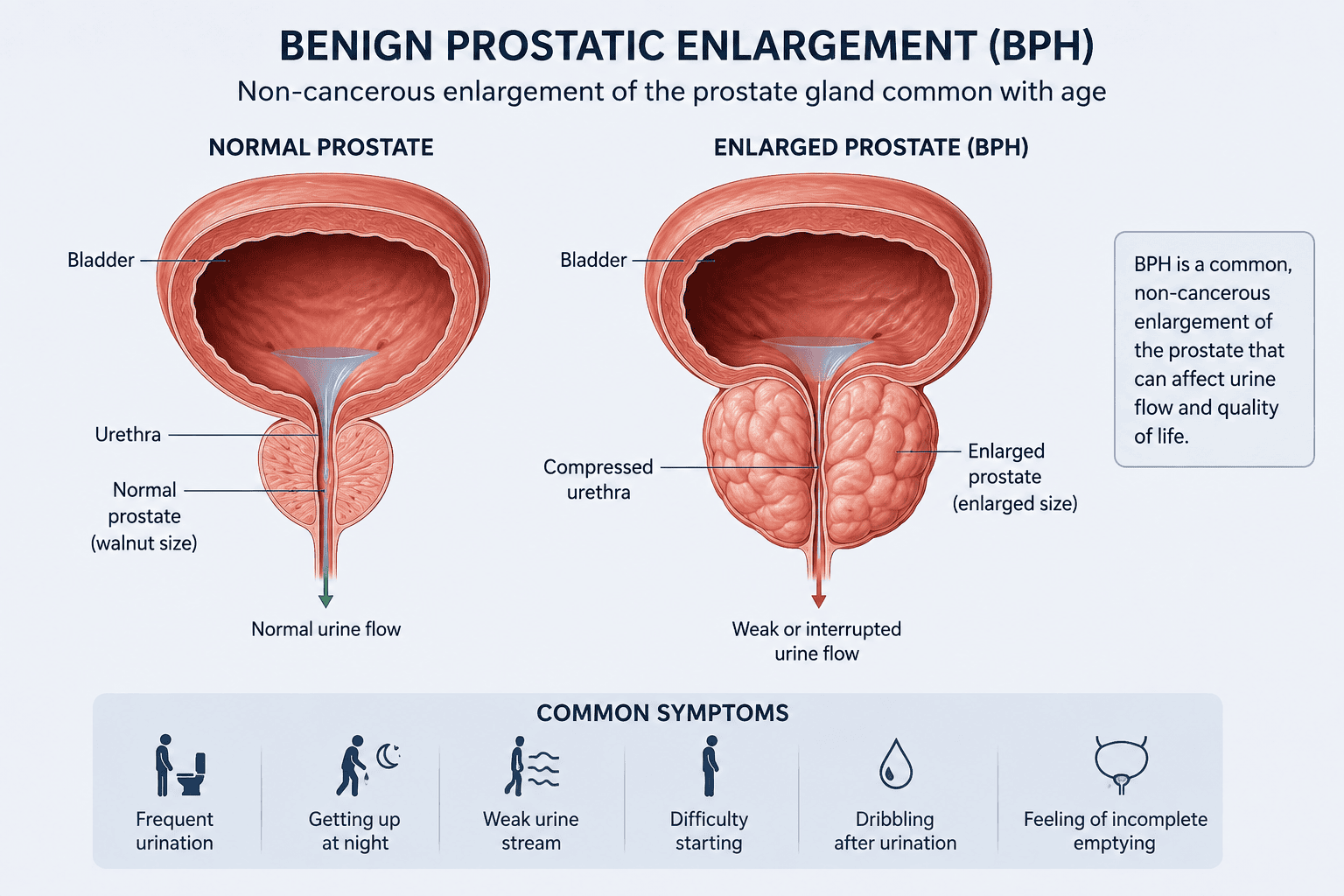
What is BPE?
BPE (benign prostatic enlargement) means the prostate gland has grown larger as men age. This is not prostate cancer; an enlarged prostate can squeeze the urine tube (urethra) and cause urinary symptoms.
Common symptoms
BPE symptoms are often called LUTS (lower urinary tract symptoms) and may include:
- Weak urine stream or trouble getting started
- Dribbling after urinating
- Feeling you didn’t empty your bladder
- Needing to urinate often, especially at night (nocturia)
- Urgency (a sudden strong need to go)
- Stopping and starting while urinating
Some men mainly have “storage symptoms” (urgency, frequency, night urination), which can overlap with overactive bladder.
When to seek urgent care?
Get same-day urgent care or emergency care if you have:
You cannot urinate at all (urinary retention)
Fever/chills with burning urination or back pain
Blood in urine that is heavy or not stopping
Severe lower belly pain with inability to pass urine
How BPE is evaluated?
Your clinician usually starts with:
- Your symptom story and medical history
- A physical exam (often including a prostate exam)
- A urine test (urinalysis) to look for infection or blood
- A symptom questionnaire like the IPSS (a scored symptom survey)
Sometimes additional tests are used (for example, checking how well the bladder empties).
Treatment options? (from least to most invasive)
Treatment depends on how bothersome symptoms are, your health, and your priorities (for example, sexual side effects, avoiding surgery, or wanting the most durable relief).
- Lifestyle and habit change: These are often the first step and can also be used with medications:
- Limit evening fluids (especially 2–3 hours before bed)
- Reduce caffeine and alcohol (can worsen urgency and nighttime urination)
- Timed voiding (urinating on a schedule)
- Pelvic floor exercises/therapy in selected patients
2. Medications : Your clinician may suggest one of these:
A. Alpha blockers (example: tamsulosin)
Often help relax the prostate/bladder outlet to improve flow and symptoms.
Possible side effects can include dizziness or sexual side effects (varies by drug).
B. 5-alpha reductase inhibitors (5-ARIs) (examples: finasteride, dutasteride)
Best for men with a larger prostate; can shrink the prostate over time and help prevent problems like urinary retention.
3. Surgical treatment:
Who usually benefits from a procedure?
A procedure is often considered when:
- Symptoms are bothersome despite medications, or you prefer not to take long-term medicine.
- You have BPE complications (for example: urine retention, recurrent infections, bladder stones, kidney problems, or bleeding).
Your urologist may recommend a procedure based on:
Prostate size and shape (including whether there is a middle lobe)
Your bleeding risk (including blood thinners)
How important it is to you to preserve ejaculation and sexual function
The main surgical/procedural options
TURP (Transurethral Resection of the Prostate) — “standard” operation
Best fit: Often used when the prostate is about 30–80 mL in size
How it works: A scope goes through the penis; extra prostate tissue is shaved out to open the channel.
What to expect: Good symptom relief and long track record.
Risks to know: Sexual side effects: Retrograde ejaculation (semen goes into the bladder) is common after TURP; erectile function changes.
Laser enucleation (HoLEP / ThuLEP) — removes the “core” of the prostate from inside
Best fit: Works across a wide range of prostate sizes; can be used best for large prostates.
How it works: A scope goes through the penis; laser separates (“enucleates”) the enlarged tissue from the capsule and removes it.
Why patients choose it: Often shorter catheter time and hospital stay and less bleeding/transfusion than classic TURP, with similar symptom improvement . Durability: In a large real-world dataset, 5-year retreatment ~4.4% after HoLEP/ThuLEP vs ~7.1% after TURP .
Sexual side effects: Retrograde ejaculation is still common. Some “ejaculation-preserving” approaches exist but are not guaranteed.
Simple prostatectomy (open, laparoscopic, or robotic) — for very large prostates
Best fit: Often considered when the prostate is >80 mL, especially if endoscopic enucleation tools/expertise are not available .
How it works: The inner enlarged part of the prostate is removed through an abdominal operation (open or minimally invasive/robotic).
Why patients may choose it: Very strong, durable relief for large glands.
Risks to know (open approach): Reported mortality <0.25% and transfusion rate ~7–14% .
Recovery: Usually longer than endoscopic options.
TUIP (Transurethral Incision of the Prostate) — a smaller procedure for small prostates
Best fit: Prostate <30 mL and no middle lobe .
How it works: Instead of removing tissue, the surgeon makes small cuts to widen the outlet.
Tradeoff: Can have a higher chance of needing another procedure later; for example, reoperation ~18.4% after TUIP vs ~7.2% after TURP.
Potential benefit: Lower retrograde ejaculation risk than TURP .
Aquablation — “waterjet” treatment
Best fit: Commonly used around 30–80 g prostates (some studies include larger glands).
How it works: A robot-guided high-pressure waterjet removes tissue; bleeding is controlled afterward.
Symptom relief: symptom improvement was similar to TURP through 12 months.
Durability (larger prostates): A trial summary reports 3.8% surgical retreatment at 5 years in a single-arm study of prostates 80–120 mL (WATER II).
Prostatic urethral lift (PUL) and water vapor therapy (Rezūm) — less invasive, faster recovery for selected men
Best fit: Usually smaller prostates (<80 g) and anatomy that fits the device; often chosen when preserving ejaculation is a top priority.
Tradeoff: Often less symptom improvement than TURP and higher chance of needing another treatment later.
Durability (real-world): In a large real-world dataset, 5-year retreatment was ~16% for PUL and ~14% for Rezūm, compared with ~7.1% for TURP .
Questions to ask your urologist
How big is my prostate (mL or grams), and do I have a middle lobe?
Which options fit my anatomy and medical conditions (especially blood thinners)?
What is the chance I will need another treatment in 5 years with each option?
What are the likely effects on ejaculation and erections for the option you recommend?
How long will I have a catheter and how long before I can return to normal activities?
This guide is not a substitute for professional medical advice. If symptoms worsen or you have new concerns, contact your doctor or seek emergency care.